Customized processing systems with superheated steam (SHS)
Customized processing systems with superheated steam (SHS)
We implement customized system solutions for industrial applications that operate with superheated steam (SHS). In doing so, we implement a wide range of thermal processes, including drying, roasting, pasteurization, and torrefaction.
Advantages of SHS over hot air

Higher drying speed
Superheated steam (SHS) has a higher heat capacity and thermal conductivity than air. This enables faster heat transfer. Drying times are reduced by 20–50% compared to conventional hot air processes – at the same product temperature.

No oxidation on the product
Since the process takes place in the absence of oxygen, oxidation of your product is virtually impossible.

Low risk of fire or explosion
The risk of fire and explosion is largely eliminated due to the oxygen-free system.

No exhaust emissions
Typically, drying processes using hot air produce odorous exhaust air that must be cleaned and removed at great expense. With SHS, there is no exhaust air.

Fully electrifiable
If the steam is generated electrically, this improves your carbon footprint in your sustainability report and significantly reduces carbon costs in the long term.
The system can be fully electrified, but also allows other energy sources such as gas or hydrogen.

Lower energy consumption
Superheated steam has a lower density than air and can therefore flow through your product more easily.
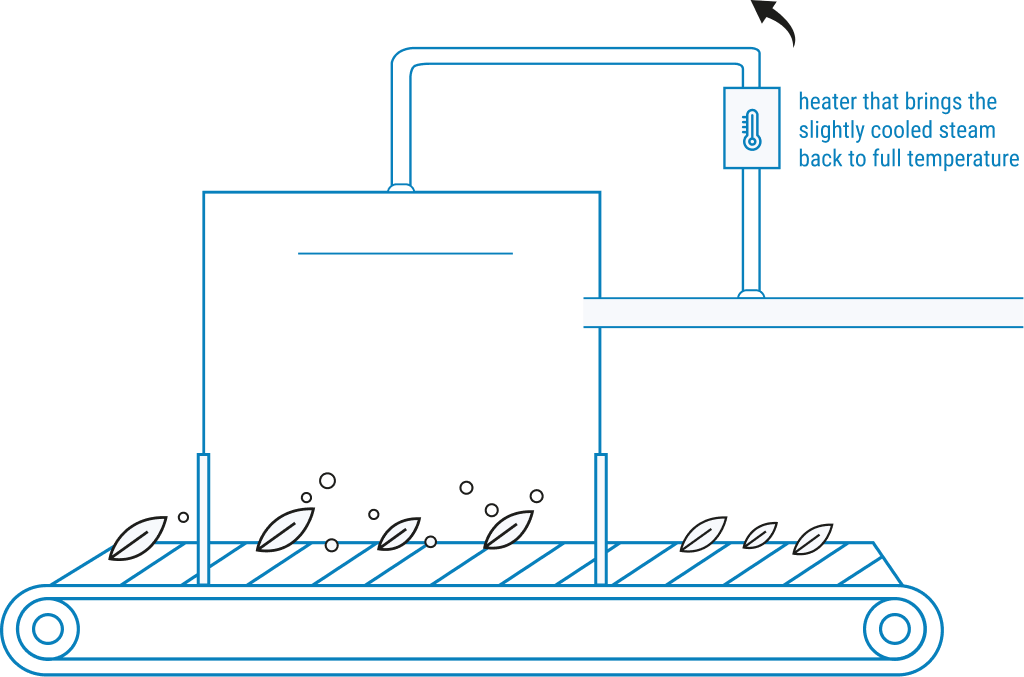
During drying, the drying medium—in this case, superheated steam—cools down slightly. The remaining energy content can be fully utilized in an SHS drying system by simply reheating the steam. Air, on the other hand, would have to be dehumidified at additional expense before heating.
The moisture contained in the product evaporates during drying. In hot air systems, it is difficult to use the resulting humid air for energy purposes. With SHS, however, the additional steam produced can be used to operate other systems, returned to the system as superheated steam by means of mechanical vapor compression, or used as warm water through condensation.
Your company may generate excess steam elsewhere, the energy content of which can be utilized in an SHS drying system.

Utilize existing infrastructure
Many industrial companies already have the infrastructure for steam generation and distribution in place. This means that additional investments may only be necessary to a limited extent.

Recovery of volatile substances
You can easily recover volatile components of the product by condensing the vapor.

Heating, drying, roasting, and pasteurizing in one system
All process steps that take place under the influence of heat, including heating, drying, pasteurization, and roasting, can be carried out using superheated steam. With precise process knowledge, product humidification can also be achieved.

How does a SHS process work?
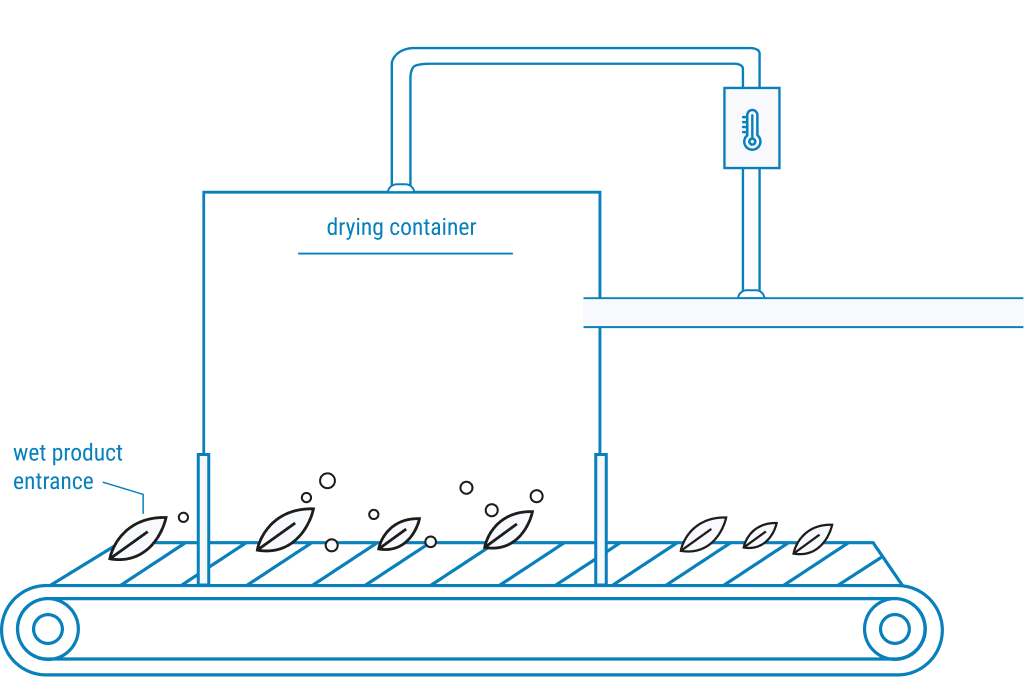
Water vapor is heated to over 100°C, creating superheated steam.
This superheated steam flows into a closed drying chamber where the product to be dried is exposed to the steam.
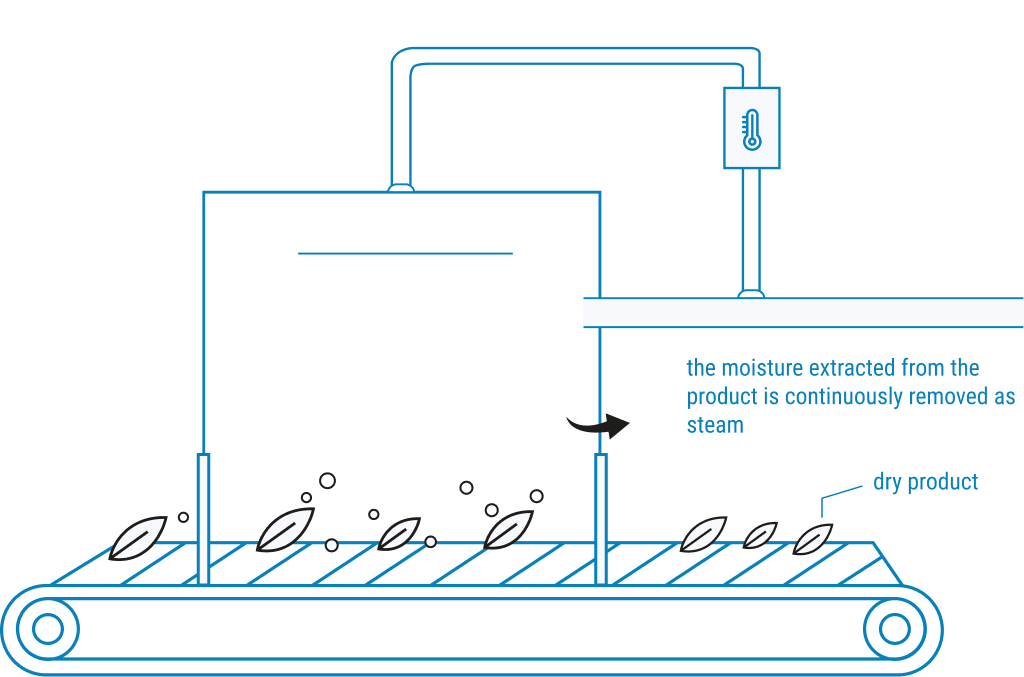
Through contact, the superheated steam extracts moisture from the product. As a result, the steam absorbs additional water and cools slightly.
The excess moisture is continuously and permanently removed from the system.
At the same time, the slightly cooled steam is reheated in a cycle process and returned to the system.

Which products are suitable?
Food
For example, croutons, nuts, seeds, vegetables, coffee beans, mushrooms, fruit pieces such as apple chips or banana slices, legumes, and much more.
Pet food
For example, dog food, cat food, treats, feed pellets, fish food, rodent food, and much more.
Pharmaceutical products
For example, active ingredient powders, tablet raw materials, excipients, granulates, pharmaceutical additives, and much more.
Mineral bulk materials
For example, mineral bulk materials, salts, sludge, sand, clay, and much more.
Building materials
For example, asphalt, drywall products and much more.
Sludges
For example sewage sludge, manure, spent grains, petrochemical sludge and much more.
We can test the following parameters in a product test:
Our laboratory and pilot systems
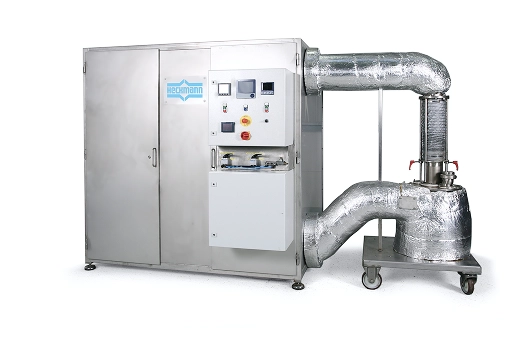
Before placing an order—or even independently of this—our four laboratory and pilot systems are at your disposal. Whether short product tests (1–2 days), comprehensive trial studies (1–2 weeks), or joint research projects with universities: we will find out whether SHS is the right process for your product and how it can be dried optimally.


Reference projects
Mill dryer: Participation in the development and manufacture of a mill drying system
Batch Dryer: First in-house laboratory dryer, “Batch Dryer Non-Food,” which is continuously modified and adapted and is still used today in our technical center for customer trials.
SolChemStor: EU research project by Fraunhofer IGB on the storage of high-temperature solar energy
BioEcoSIM: SHS drying system for an EU research project by Fraunhofer IGB on the processing of manure into various fertilizers
HiPerDry: (Microwave-combined) SHS drying system for an EU research project by Fraunhofer IGB on the drying of plastic granulates
Screw dryer: Development of an SHS screw dryer
BioEcoSIM
HiPerDry
Screw Dryer
Belt dryer: Development and manufacture of a belt dryer as a pilot system for use in the beverage industry according to customer requirements
EnReMilk: Development and construction of an SHS spray dryer for the production of milk powder as part of an EU research project by Fraunhofer IGB
SmartDry: Fraunhofer IGB EU research project Development and construction of a belt dryer. The aim is to develop an intelligent control system for the dryer that enables the desired output moisture content of the product to be generated consistently, regardless of the input moisture content. Since the end of the project, the SmartDry belt dryer has been one of our technical center facilities, which we use to conduct product trials for customers.
Fluid Bed Dryer: Development and manufacture of an SHS jet layer dryer for drying foodstuffs – long-term cooperation with several institutes in accordance with customer requirements – now used as a fluidized bed dryer in our technical center
Collaboration with Bioretur from Norway to sell and manufacture an SHS sludge dryer in the DACH region. This dryer was developed in fish farming and is designed for the energy-efficient drying of organic sludge, but is also suitable for various other areas of application.
with bioreture
Belt dryer: Involvement in the development and manufacture of our first SHS belt dryer as a pilot project for drying pet food according to customer requirements.
Roaster: First prototype of the SHS coffee roaster with vibrating bed
PhosFarm: SHS drying system for an EU research project conducted by Fraunhofer IGB on the recovery of phosphorus from agricultural waste
GOBi: SHS drying system for recovering salts from fermentation residues as part of the Fraunhofer IGB's EU research project on optimizing biogas plants.
Tray Dryer: SHS trade fair dryer Heckmann/Fraunhofer IGB for the ANUGA trade fair
Tray Dryer
SteamBio: Fraunhofer IGB EU research project to develop an SHS drying machine for wood chips. The aim is to extract certain substances from the condensate produced, e.g. for the production of bioplastics.
Valorkon: EU research project of the Fraunhofer IGB for which we built an SHS drying system that torrefies wood and recovers volatile substances from the wood via condensate recovery, making them usable again.
Batch Dryer: Second in-house laboratory dryer, “Batch Dryer Food,” which is constantly being modified and adapted and is still used in our technical center for customer trials.
Batch Dryer
Since 2023: Establishment of our technical center in Rethem, Lower Saxony. Focus on direct industrial applications.
Reference projects
Belt Dryer
Involvement in the development and production of our first SHS belt dryer as a pilot plant for drying pet food according to customer requirements
Mill Dryer
Involvement in the development and manufacture of a mill-drying plant
Roaster
First prototype of the SHS coffee roaster with vibrating bed
Batch Dryer
First in-house laboratory dryer “Batch Dryer Non-Food”, which is constantly being modified and adapted and is still used today in our technical center for customer tests
Phosfarm
SHS drying plant for an EU research project by Fraunhofer IGB to recover phosphorus from agricultural waste
SolChemStore
Fraunhofer IGB's EU research project to store high-temperature solar energy
BioEcoSIM
SHS drying plant for an EU research project by Fraunhofer IGB to process manure into various fertilizers
HiPerDry
(combined with microwaves) SHS drying system for an EU research project by Fraunhofer IGB for drying plastic granules
Screw Dryer
Development of a SHS screw dryer
Gobi
SHS drying plant for the recovery of salts from fermentation residues as part of Fraunhofer IGB's EU research project to optimize biogas plants.
Tray Dryer
SHS trade fair dryer Heckmann/Fraunhofer IGB for the ANUGA trade fair
Belt Dryer
Development and production of a belt dryer as a pilot plant for use in the beverage industry according to customer requirements
EnReMilk
Development and construction of an SHS mixer for the production of milk powder as part of an EU research project by Fraunhofer IGB
Steambio
Fraunhofer IGB EU research project to develop an SHS drying machine for wood chips. The aim is to obtain certain ingredients from the resulting condensate, e.g. for the production of organic plastic.
Smart Dry
Fraunhofer IGB EU research project Development and construction of a belt dryer. The aim is to develop an intelligent control system for the dryer, which makes it possible to always generate the same desired initial humidity of the product regardless of the initial humidity of the product. Since the end of the project, the SmartDry, as a belt dryer, has been one of our pilot plants, with which we carry out product tests for customers.
Valorkon
EU research project by Fraunhofer IGB for which we built an SHS drying plant that torrefies wood and extracts volatile substances from the wood through condensate recovery and makes them reusable.
Batch Dryer
Second in-house laboratory dryer “Batch Dryer Food”, which is constantly being modified and adapted and is still used today in our technical center for customer tests.
Fluid Bed Dryer
Development and production of an SHS jet layer dryer for drying food — long-term cooperation with several institutes according to customer requirements — today as a fluidized bed dryer in our technical center
Technikum
Since 2023: Establishment of our technical center in Rethem, Lower Saxony. Focus on direct industrial applications
Cooperation with Bioretur
Cooperation with Bioretur from Norway to sell and manufacture an SHS sludge dryer in the DACH region. This dryer was developed in fish farming and is designed for the energy-efficient drying of organic sludge, but is also suitable for various other areas of application.

Salmon farming in Norway
As a partner, Heckmann manufactures the SHS drying systems developed by Bioretur specifically for sludge in Norway.
Bioretur has developed the plant technology specifically for the efficient processing of sludge and is already successfully using it in Norway.
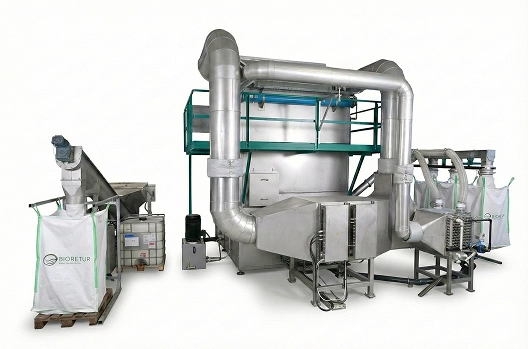
On the right, a plant of this construction method is used in Norwegian salmon farming to process fish sludge. The plant concept can be directly transferred to other sludge drying industries.
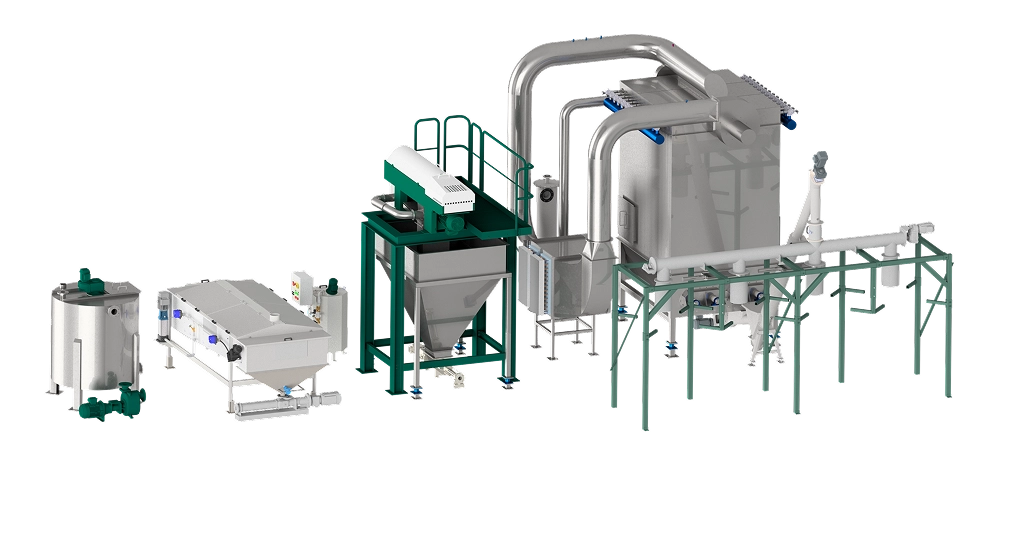
In this tank, sludge from the production process is collected.The sludge typically has a dry matter content between 0.1 – 0.5%.
Polymer is added to aggregate the dry matter in the sludge into larger clumps. This makes it easier to separate the water, resulting in a cleaner effluent. The type and dosage of polymer are chosen based on what best suits the material.
The belt filter removes most of the water from the sludge and is the first step in the mechanical dewatering process. The dry matter content of the sludge here reaches at least 4 – 5%.
The decanter centrifuges more water out of the sludge, increasing the dry matter content to between 20 – 30%. The effluent is sent back for further thickening and filtration.
Stores the sludge from the decanter before it is fed into the dryer.
This dryer is based on superheated steam technology, which evaporates the water and results in a hygienised and dry powder with over 90% dry matter content.
Reduces odor and condenses vapors from the drying process.
The hygienised and storage-stable sludge is transported out of the dryer in a semi-continuous process and into a distribution screw that fills big bags with sludge. The dry sludge is weighed and labeled before being picked up for further handling.
This loop extracts residual heat from the dryer, which can be used to meet heating needs at the aquaculture facility.
Sludge dryer
The Norwegian company Bioretur has developed a sludge dryer that uses superheated steam for the energy-efficient drying and processing of sludge-like materials from fish farming. However, this plant concept is not limited to this application; it can also be used for various types of sludge in different industries, such as sewage or industrial sludge.
The single module plant shown on the right has a capacity of 300 kg/h of input material and can be expanded to increase throughput. From four single modules onwards, additional components can be integrated for energy recovery. This significantly reduces energy consumption.
Heckmann is the industrial partner and responsible for the distribution and manufacturing of these systems in the DACH region.
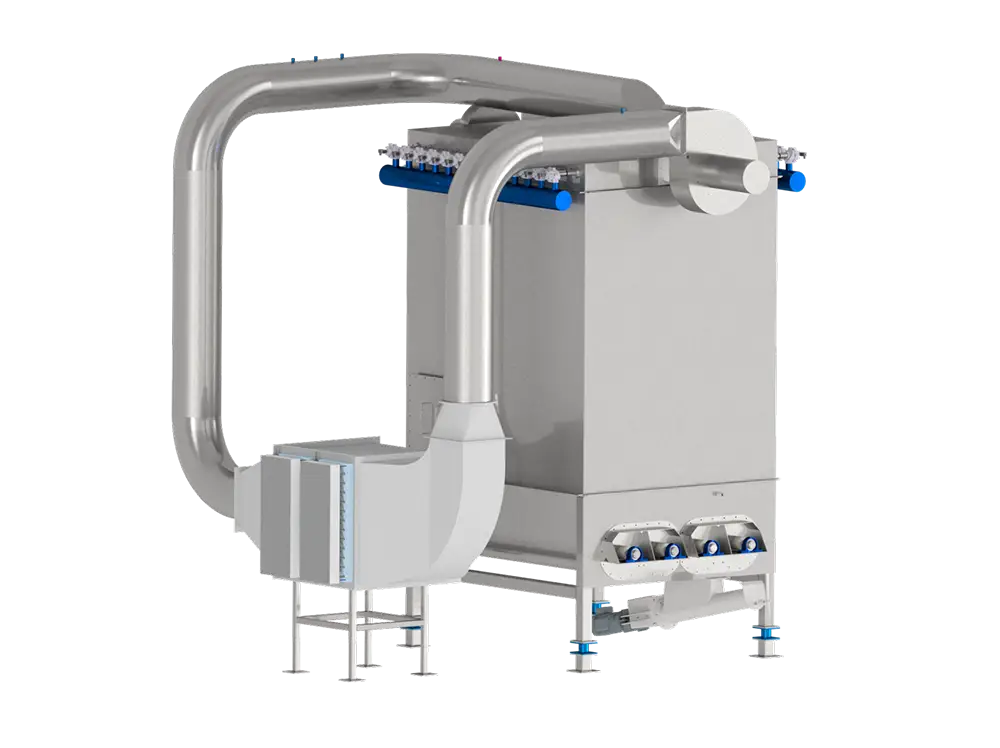
Steam passes through the heater module and reaches a temperature of 180°C. The steam is then referred to as superheated.
(Not visible in the drawing) Excess steam generated during the drying process is removed from the system.
The superheated steam is sent back into the mixing chamber to dry the wet material. The outlet is positioned below the filters to create good circulation within the dryer.
Short bursts of air are sent through the filters to shake off any biomass that may have become stuck.
Contains over 130 filter sleeves. The steam is drawn out through the filters before being reheated.
Wet organic biomass is fed into the mixing chamber, where it meets a bed of dried material and superheated steam. The particles are dried and hygienised within seconds.
Sludge dryer
The Norwegian company Bioretur has developed a sludge dryer that uses superheated steam for the energy-efficient drying and processing of sludge-like materials from fish farming. However, this plant concept is not limited to this application; it can also be used for various types of sludge in different industries, such as sewage or industrial sludge.
The single module plant shown below has a capacity of 300 kg/h of input material and can be expanded to increase throughput. From four single modules onwards, additional components can be integrated for energy recovery. This significantly reduces energy consumption.
Heckmann is the industrial partner and responsible for the distribution and manufacturing of these systems in the DACH region.
Der Dampf strömt durch das Heizmodul und erreicht eine Temperatur von 180 °C. Anschließend wird der Dampf als überhitzter Dampf bezeichnet.
(In der Zeichnung nicht sichtbar) Überschüssiger Dampf, der während des Trocknungsprozesses entsteht, wird aus dem System abgeführt.
Der überhitzte Dampf wird zurück in die Mischkammer geleitet, um das feuchte Material zu trocknen. Der Auslass ist unterhalb der Filter positioniert, um eine gute Zirkulation im Trockner zu gewährleisten.
Kurze Luftstöße werden durch die Filter geleitet, um eventuell festgesetzte Biomasse abzuschütteln.
Enthält über 130 Filterschläuche. Der Dampf wird durch die Filter abgesaugt, bevor er erneut erhitzt wird.
Feuchte organische Biomasse wird in die Mischkammer eingebracht, wo sie auf ein Bett aus getrocknetem Material und überhitztem Dampf trifft. Die Partikel werden innerhalb von Sekunden getrocknet und hygienisiert.
Heater Module
Steam passes through the heater module and reaches a temperature of 180°C. The steam is then referred to as superheated.
Bleed-Off System
(Not visible in the drawing) Excess steam generated during the drying process is removed from the system.
Steam Inlet
The superheated steam is sent back into the mixing chamber to dry the wet material. The outlet is positioned below the filters to create good circulation within the dryer.
Compressed Air System
Short bursts of air are sent through the filters to shake off any biomass that may have become stuck.
Filter Housing
Contains over 130 filter sleeves. The steam is drawn out through the filters before being reheated.
Mixing Chamber with Rotors
Wet organic biomass is fed into the mixing chamber, where it meets a bed of dried material and superheated steam. The particles are dried and hygienised within seconds.
Salmon farming in Norway
As a partner, Heckmann manufactures the SHS drying systems developed by Bioretur specifically for sludge in Norway.
Bioretur has developed the plant technology specifically for the efficient processing of sludge and is already successfully using it in Norway.
On the right, a plant of this construction method is used in Norwegian salmon farming to process fish sludge. The plant concept can be directly transferred to other sludge drying industries.
In diesem Tank wird der Schlamm aus dem Produktionsprozess gesammelt.
Der Schlamm weist typischerweise einen Trockensubstanzgehalt zwischen 0,1–0,5 % auf.
Dem Schlamm wird Polymer zugesetzt, um die Trockensubstanz zu größeren Flocken zu aggregieren. Dadurch lässt sich das Wasser leichter abtrennen, was zu einem saubereren Ablauf führt. Art und Dosierung des Polymers werden je nach den Eigenschaften des Materials ausgewählt.
Der Bandfilter entfernt den Großteil des Wassers aus dem Schlamm und ist der erste Schritt im mechanischen Entwässerungsprozess. Der Trockensubstanzgehalt des Schlamms erreicht hier mindestens 4–5 %.
Der Dekanter zentrifugiert weiteres Wasser aus dem Schlamm und erhöht den Trockensubstanzgehalt auf etwa 20–30 %. Das Filtrat wird zur weiteren Eindickung und Filtration zurückgeführt.
Lagert den Schlamm aus dem Dekanter, bevor er dem Trockner zugeführt wird.
Dieser Trockner basiert auf der Technologie des überhitzten Dampfes, der das Wasser verdampft und ein hygienisiertes, trockenes Pulver mit einem Trockensubstanzgehalt von über 90 % erzeugt.
Reduziert Gerüche und kondensiert Dämpfe aus dem Trocknungsprozess.
Der hygienisierte und lagerstabile Schlamm wird in einem halbkontinuierlichen Prozess aus dem Trockner ausgetragen und einer Verteilerschnecke zugeführt, die Big Bags mit Schlamm befüllt. Der getrocknete Schlamm wird gewogen und etikettiert, bevor er zur weiteren Verarbeitung abgeholt wird.
Dieser Kreislauf entzieht dem Trockner die verbleibende Abwärme, die zur Deckung des Heizbedarfs der Aquakulturanlage genutzt werden kann.
Holding tank
In this tank, sludge from the production process is collected.The sludge typically has a dry matter content between 0.1 – 0.5%.
Thickening
Polymer is added to aggregate the dry matter in the sludge into larger clumps. This makes it easier to separate the water, resulting in a cleaner effluent. The type and dosage of polymer are chosen based on what best suits the material.
Belt Filter
The belt filter removes most of the water from the sludge and is the first step in the mechanical dewatering process. The dry matter content of the sludge here reaches at least 4 – 5%.
Decanter
The decanter centrifuges more water out of the sludge, increasing the dry matter content to between 20 – 30%. The effluent is sent back for further thickening and filtration.
Sludge Tank
Stores the sludge from the decanter before it is fed into the dryer.
Bioretur SHS Dryer
This dryer is based on superheated steam technology, which evaporates the water and results in a hygienised and dry powder with over 90% dry matter content.
Scrubber
Reduces odor and condenses vapors from the drying process.
Collection of sludge
The hygienised and storage-stable sludge is transported out of the dryer in a semi-continuous process and into a distribution screw that fills big bags with sludge. The dry sludge is weighed and labeled before being picked up for further handling.
Heat recovery
This loop extracts residual heat from the dryer, which can be used to meet heating needs at the aquaculture facility.
Hecki coffee
In contrast to conventional methods using hot air, the patented roasting process developed by Hecki uses superheated steam.
As a result, the coffee beans are roasted particularly gently and evenly — without contact with oxygen. The process produces hardly any immissions and does not require complex exhaust gas purification.
A patented process is in which a roasting gas stream of 70-90% superheated steam circulates through the beans at least 150 °C — an innovative step for quality and the environment.


About Heckmann Group
The Heckmann Group is a family-run mechanical and plant engineering company. Since its foundation in 1974, it has developed into a medium-sized company with several locations. With around 550 employees, the group offers tailor-made solutions for various industries.
The Heckmann Group is a family-run mechanical and plant engineering company.
Since its foundation in 1974, it has developed into a medium-sized company with several locations.
With around 550 employees, the group offers tailor-made solutions for various industries.


known companies already place their trust in Heckmann

%202.png)


%202.png)








%202.png)







This is how your project will proceed
Initial consultation
In an initial discussion, we will clarify your use case together and define the rough framework.


Tests
We conduct practical tests at our pilot plants to determine the optimal drying parameters for your product.
Process design & quotation
Based on your application, we will develop the appropriate process design and prepare a customized quote.
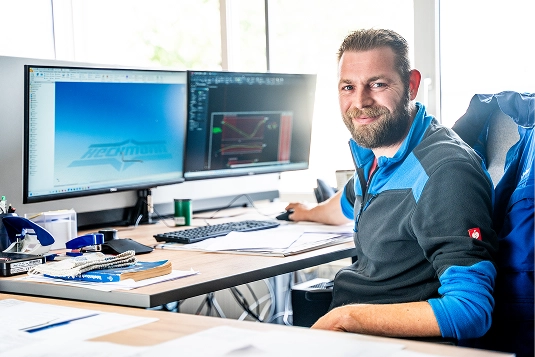

Construction
We take care of all electrical and mechanical engineering as well as design.
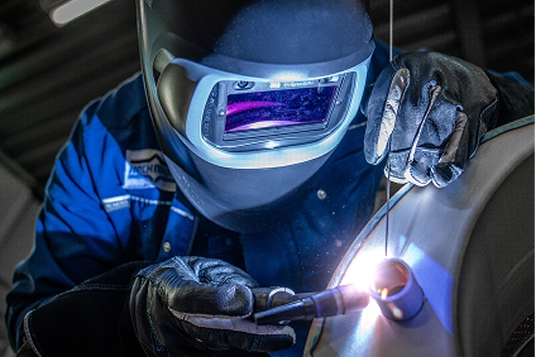
Manufacturing
We manufacture your drying plant mechanically and electrically.
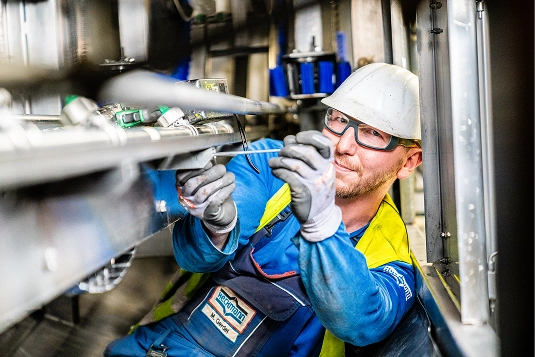
Installation & commissioning
We take care of the safe transport, professional installation, and smooth commissioning of your system.
After Sales Service
We supply replacement and wear parts, perform maintenance and repairs—and can even do so remotely if desired.

André Nitzsche
Submit a request
Submit a request